Best Shocks for Ford F-150 2020 (Smooth Ride, Better Stability & Less Vibration)
If Your F-150 Still Feels Slightly Off at Highway Speed
At some point, many F-150 owners reach this exact stage.
You’ve already done what most people would do first.
You checked tire balance, looked into braking, maybe even replaced the brake pads.
Things improved… but not completely.
The truck drives better, sure — but there’s still that subtle feeling in the background.
Not a major issue.
Not something you can clearly point to.
Just that sense that the truck doesn’t feel as stable, as planted, or as sorted as it should—especially at highway speeds.
And if you’ve gone through this, you’re definitely not alone.
In fact, this is exactly where many owners land after reading: “Ford F-150 2020 Shaking at 60 MPH? Real Causes & Fixes That Actually Work”
That guide helps you understand why the issue happens.
But this is where things get more specific.
What do you do when the obvious fixes are done… and the truck still doesn’t feel quite right?
Where Shocks Quietly Become the Missing Piece
Here’s something most people don’t immediately think about.
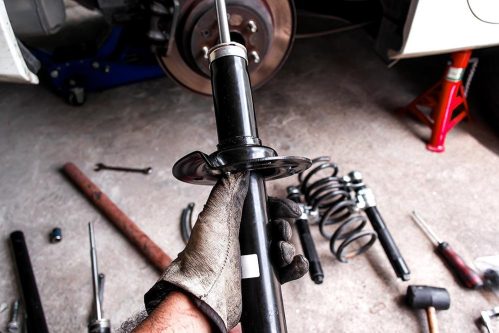
Shocks are often associated with comfort—how soft or firm the ride feels. But in reality, their role goes much deeper than that. They are constantly working in the background to control how the truck behaves after every small movement.
And those movements happen more often than you think:
- Slight road imperfections you barely notice
- Subtle speed changes
- Weight shifting forward when you brake
- Small undulations on the highway
Every time something like this happens, shocks are responsible for bringing the truck back to stability.
Not just absorbing the movement—but controlling how quickly and smoothly the truck settles.
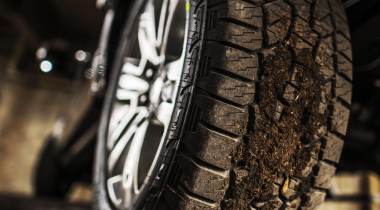
In many cases, what feels like vibration is not always coming from suspension alone — it can also start from how the tires interact with the road → Best Tires for Ford F-150 2020
What Happens When Shocks Start Wearing Out
When Does It Actually Make Sense to Replace Shocks?
Now before jumping to conclusions, let’s be clear- not every situation requires new shocks.
But based on how these issues typically show up, it starts to make practical sense when:
- The truck feels slightly bouncy, even over small bumps
- Highway driving doesn’t feel as stable or confidence-inspiring as before
- You’ve already addressed tires and brakes, but something still feels off
- The truck has crossed moderate mileage (around 40K–60K+), where performance naturally starts to decline
At this stage, you’re not dealing with a sudden failure. Rather you’re dealing with a gradual loss of control that has built up over time.
And replacing shocks isn’t about fixing something “broken.”
It’s about bringing back that planted, stable, predictable feel your truck had when everything was working as it should.
Best Shocks for Ford F-150 2020 (Real-World Usage Focus)
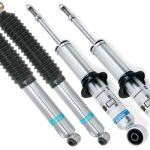
1. Bilstein 5100 Series Shocks (Best for Highway Stability & Control)
If your main goal is to make your F-150 feel more stable and planted — especially at highway speeds — Bilstein 5100 is one of those upgrades that stands out not just because of brand reputation, but because of how differently it behaves compared to standard factory shocks.
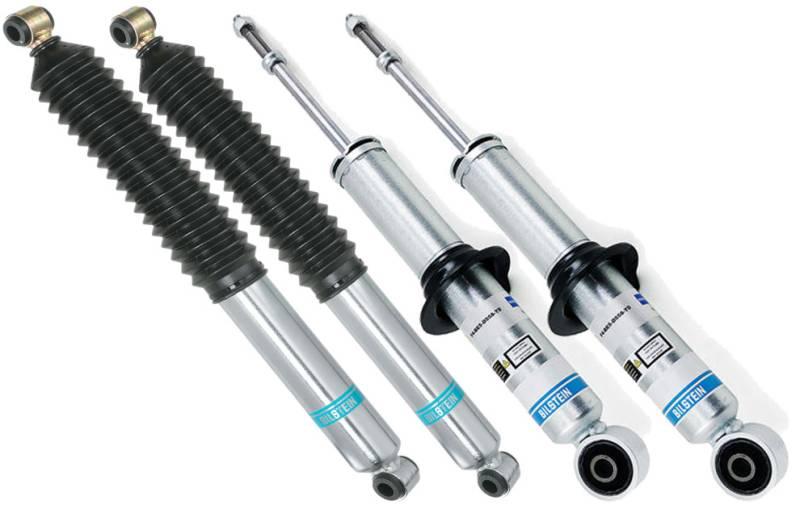
What really separates this setup from most stock or budget shocks is its monotube high gas-pressure design. Wihtout going too technical, most factory shocks are twin-tube, which means they prioritize comfort and softness. They absorb bumps well at low speeds, but at highway speeds they tend to feel slightly “floaty” because they don’t control movement as tightly.
Bilstein 5100, on the other hand, uses a single-tube (monotube) design with high-pressure gas, which allows it to react much faster to road inputs. That faster response is what keeps the truck more controlled instead of letting it bounce or sway slightly after every bump.
That’s a big deal in real driving.
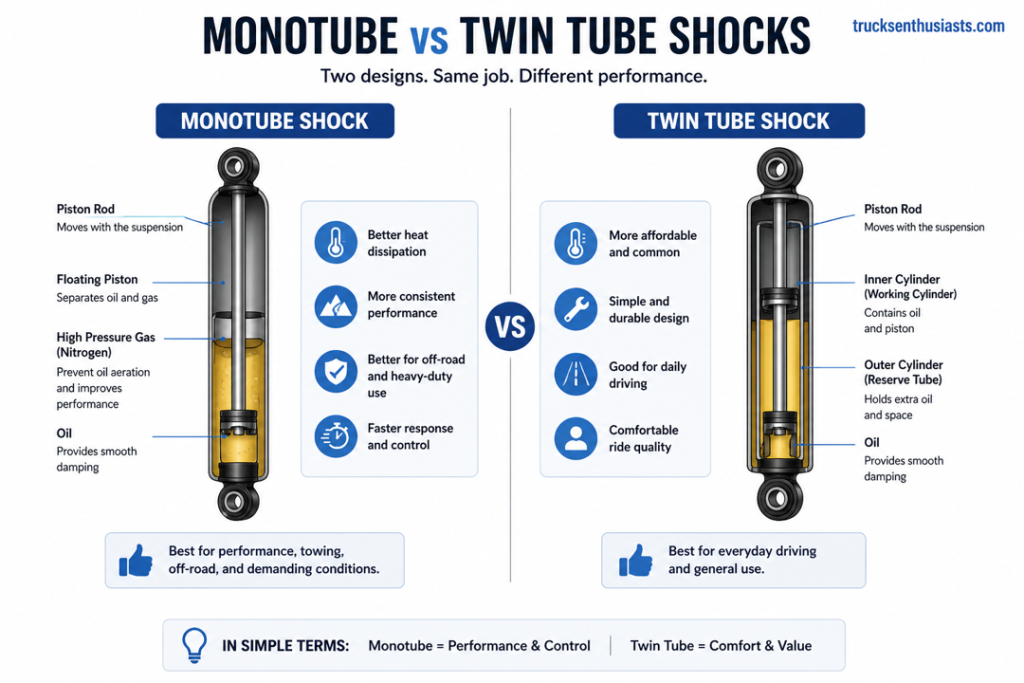
Because most of the “vibration” or instability people feel at highway speeds isn’t from big bumps — it’s from small, repeated movements that the suspension isn’t controlling tightly enough. The Bilstein 5100 is specifically good at managing those micro-movements, which is why the truck starts to feel more composed rather than just softer.
Another practical advantage is that many 5100 setups also support slight ride height adjustment (leveling), which helps improve front-end stance and overall balance — something that indirectly improves stability as well.
When to choose these shocks
This setup really shines when your usage is more about consistency and control rather than heavy-duty load handling or off-road extremes.
If your truck is mostly used for:
- Highway driving
- Long-distance travel
- Daily commuting where stability matters
then this is where you’ll actually feel the benefit.
Compared to stock shocks, these don’t try to make the ride softer — they make it more controlled. And that’s an important distinction, because a lot of instability comes from too much uncontrolled movement, not from stiffness.
In simple terms, these don’t “cushion” the truck more — they settle it faster and keep it composed.
What can u expect after installing this
The difference doesn’t hit you instantly like a dramatic upgrade — but after a few drives, it becomes very clear what’s changed.
- The truck feels more planted at highway speeds
- That slight floating or wandering sensation reduces
- Steering starts to feel more predictable and connected
- The truck settles quicker after bumps instead of oscillating
It’s the kind of improvement where the truck just feels tighter and more controlled overall — especially on longer drives.
- Excellent highway stability and control, especially at speed
- Monotube design responds faster than standard twin-tube shocks
- Helps reduce floaty or unstable feeling
- Durable build quality (known to last longer than stock)
- Optional ride height adjustment adds extra value
- Slightly firmer than stock, which some drivers may notice initially
- Not designed specifically for heavy towing or load support
- Less focused on extreme off-road comfort compared to premium off-road shock
Final Take on Bilstein 5100
If your F-150 doesn’t feel “broken” but just doesn’t feel as stable or confident as it used to — especially at highway speeds — this is one of the most effective upgrades you can make.
It’s not about making the ride softer or more aggressive.
It’s about making the truck feel controlled, planted, and predictable again — which is exactly what most owners are actually looking for.
Check for compatibility : 2020 Ford F150 Bilstein 5100 shocks
2. Monroe Load Adjusting Shocks (Best for Load Support & Daily Comfort)
If your truck feels fine most of the time, but the moment you add weight — whether it’s cargo, passengers, or even a trailer — it starts to feel a bit unbalanced or saggy in the rear, then this is exactly where something like Monroe load-adjusting shocks starts to make a lot more sense than performance-focused options.
Because at that point, the problem isn’t really about control — it’s about support.
Most shocks, including something like Bilstein, are designed to control how the suspension moves. But they don’t actually help carry weight. So when extra load is added, the rear of the truck dips slightly, which changes the balance of the vehicle and can make braking, steering, and overall stability feel off.
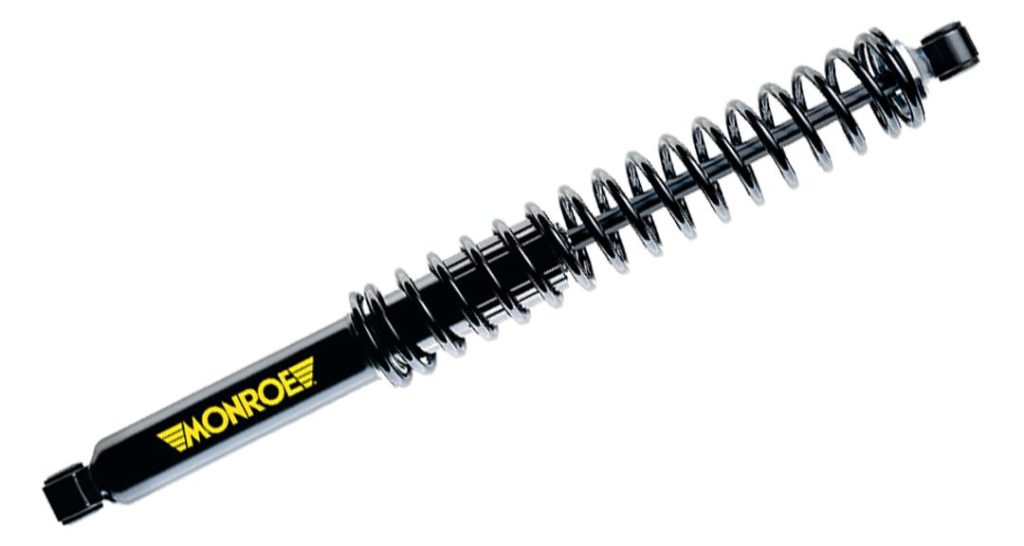
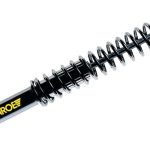
Monroe Shocks for Ford F150
Monroe approaches this differently by adding a coil spring assist directly onto the shock. That means instead of just reacting to movement, it actively helps support the additional weight. And that changes how the truck behaves under load in a very noticeable way.
When can you go for Monroe Shocks
This setup becomes especially useful when your truck isn’t always loaded — but sometimes is.
For example:
- You carry tools or equipment occasionally
- You take longer trips with luggage
- You tow once in a while
- Or you simply notice the rear dipping more than it should
In those situations, a performance shock might make the ride feel tighter — but it won’t fix the underlying imbalance caused by weight.
Monroe, on the other hand, directly addresses that imbalance.
What can you get after installing Monroe Shocks
The difference tends to show up the moment the truck is under load.
Instead of the rear end dropping and making the truck feel slightly off-balance, it stays more level. That alone changes how everything feels — braking becomes more stable, steering feels more predictable, and the truck doesn’t feel like it’s “dragging” from the back.
Even during regular driving, many people notice that the ride feels more comfortable and composed, especially if their old suspension was already worn.
It’s not about making the truck feel sporty or aggressive.
It’s about making it feel balanced and stable in real-world situations.
- Built-in coil spring helps support extra weight
- Reduces rear sag effectively
- Improves ride comfort under load
- Budget-friendly compared to premium shocks
- Doesn’t improve high-speed control as much as monotube shocks
- Less precise handling compared to Bilstein
- Not designed for performance driving
- Can feel “soft” when unloaded
Final Take on Monroe
If your issue shows up when the truck is carrying weight — not just when it’s empty — this is one of the most practical upgrades you can make.
It doesn’t try to improve performance in every scenario.
It simply makes sure your truck handles load the way it’s supposed to.
Check for compatibility : 2020 Ford F150 Monroe shocks
3. FOX 2.0 Performance Series Shocks (Best for Premium Ride & All-Terrain Consistency)
Now, if you’re looking for something that doesn’t just fix a specific issue but actually upgrades how your truck feels across different conditions, this is where FOX 2.0 starts to stand out.
Because unlike Monroe (which focuses on load) or Bilstein (which focuses on control), FOX is designed to deliver a more consistent and refined experience across everything — highway, rough roads, and even occasional off-road use.
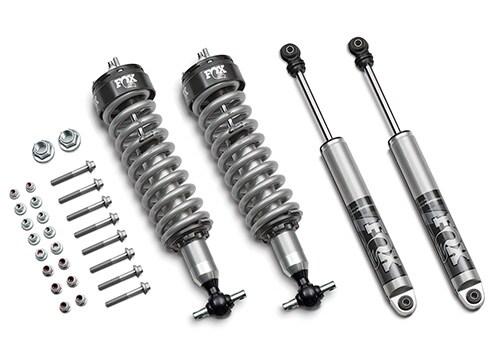
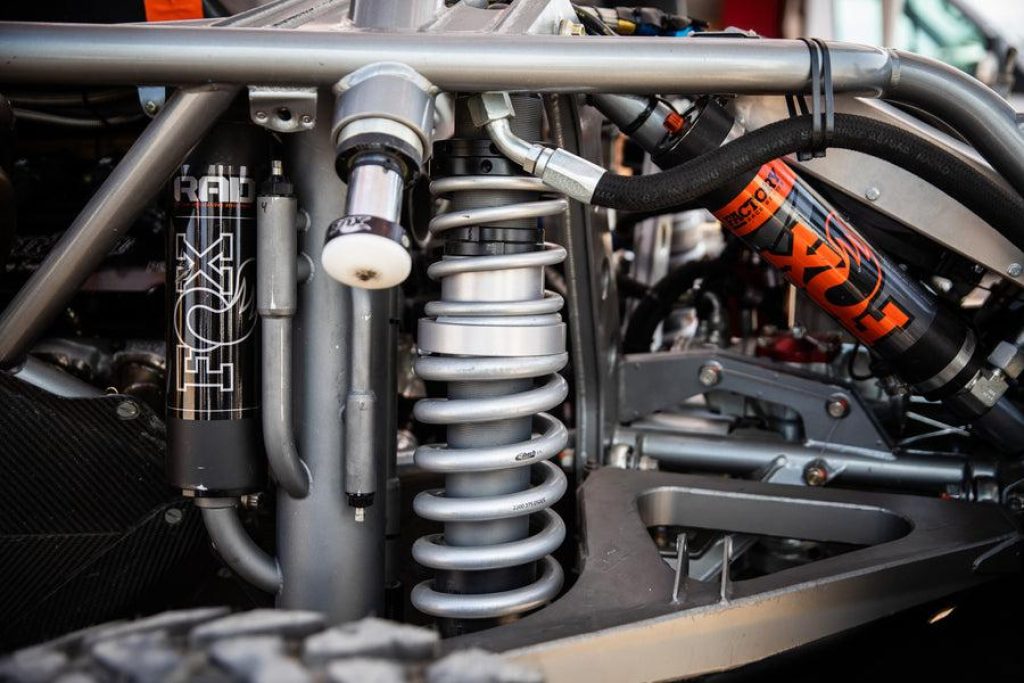
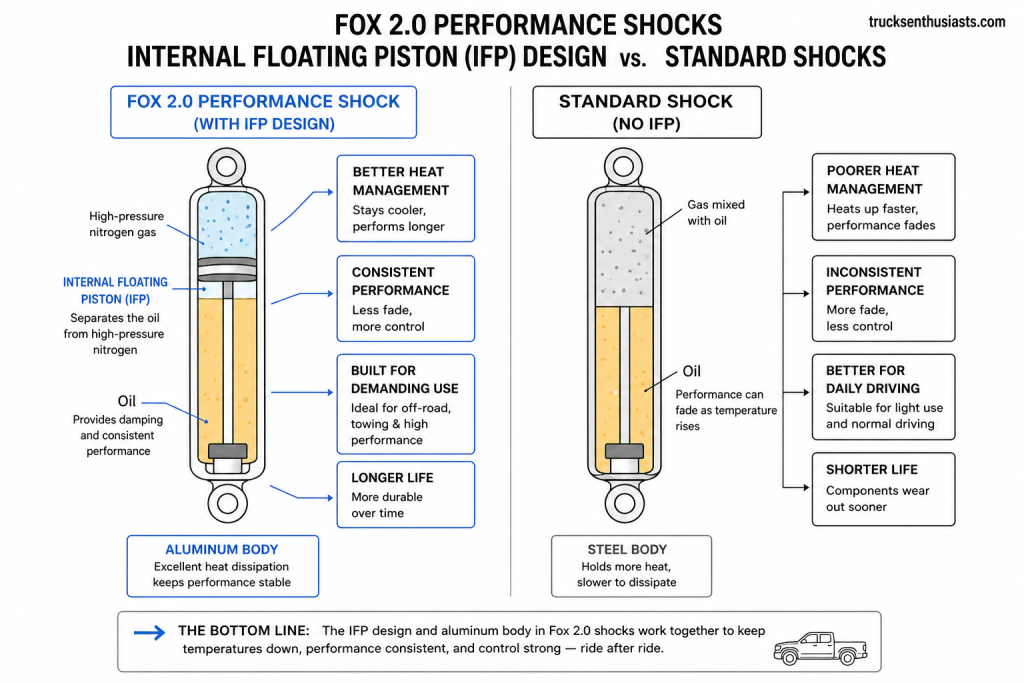
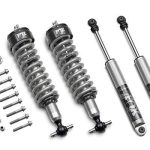
What makes this possible is its Internal Floating Piston (IFP) design combined with an aluminum body, which helps manage heat much more effectively than standard shocks. That might sound like a small detail, but it plays a big role in how the suspension performs over time.
Most basic shocks feel fine initially — but after repeated bumps, long drives, or rough terrain, they start to lose consistency.
FOX is built to avoid that.
When can you go for Fox performance shocks
This setup is ideal when your driving isn’t limited to one type of condition.
For example:
- You drive on highways during the week
- Hit rough or uneven roads occasionally
- Maybe go off-road once in a while
- Or just want the truck to feel more “premium” overall
In those cases, choosing something too specialized (like load-only or highway-only shocks) can feel limiting.
FOX sits right in the middle — and handles everything well.
What results you can expect after installing these shocks
The first thing most people notice is not stiffness or softness — it’s consistency.
The truck feels composed across different surfaces. Whether you’re driving on a smooth highway or a slightly rough patch of road, the suspension behaves in a more predictable way.
Bumps feel more controlled, not abrupt.
The truck doesn’t bounce or float — it just absorbs and settles.
Over time, that translates into a driving experience that feels more refined and confidence-inspiring.
- Excellent balance of comfort + control
- Handles heat and repeated stress very well
- Premium build quality (aluminum body)
- Performs well across multiple terrains
- Expensive compared to other options
- Overkill for simple daily driving
- Doesn’t provide load support like Monroe
- Not as “tight” as Bilstein for highway-focused users
Final Take on FOX 2.0
If you’re not just fixing a problem, but actually looking to improve how your truck feels in every situation, this is one of the most complete upgrades you can go with.
It’s not the cheapest option, and it’s not meant for basic use.
But if you want your truck to feel consistently good across everything you drive on, this is where FOX really stands out.
Check for compatibility : 2020 Ford F150 Fox 2.0 performance shocks
Comparing all these options
| Features |
 Bistein 5100 shocks |
 Monroe Load adjusting Shocks |
 Fox 2.0 performance shocks |
|---|---|---|---|
| Primary Focus | Stability & control | Load support | All-terrain performance |
| Design Type | Monotube | Twin-tube + coil assist | IFP monotube |
| Best Use Case | Highway driving | Carrying load / towing | Mixed terrain driving |
| Ride Feel | Firm & controlled | Soft under load | Balanced & refined |
| Load Handling | ❌ Limited | ✅ Strong | ❌ Moderate |
| Highway Stability | ✅ Excellent | ⚠️ Moderate | ✅ Good |
| Off-road Capability | ⚠️ Moderate | ❌ Low | ✅ High |
| Price Range | Medium | Low | High |
A Simple Way to Decide What Actually Fits Your Truck
At this point, it’s easy to get stuck comparing specs or trying to figure out which one is “best overall.” But in reality, the right choice becomes much clearer when you think about how your truck is actually used on a daily basis.
If most of your driving happens on highways and your main concern is that slightly loose or floaty feeling at speed, then something like the Bilstein setup tends to make more sense, because it focuses on control and helps the truck feel more planted and predictable.
On the other hand, if your truck feels fine when empty but starts to sag or feel unbalanced the moment you add weight — whether that’s cargo or occasional towing — then a load-supporting setup like Monroe is usually the more practical choice, since it directly addresses that imbalance rather than just tightening the ride.
And if your usage is more of a mix — some highway driving, some rough roads, maybe occasional off-road — and you’re simply looking for the truck to feel better overall without leaning too heavily in one direction, then something like FOX tends to feel like the most complete option, because it focuses on consistency across different conditions rather than specializing in just one.
In the end, there isn’t a single “best shock” for everyone — it really comes down to what your truck needs the most right now. If you match the setup to your usage, the improvement feels natural and noticeable, rather than forced or overdone.
If you’re working through this step-by-step, the goal isn’t just to replace shocks — it’s to fix the overall driving feel of your truck.
The easiest way to approach that is:
- Start with understanding the issue →Ford F-150 2020 Shaking at 60 MPH
- Then follow a structured fix →How to Fix Vibration in Ford F-150 2020
- And then go deeper based on what your truck needs:
- Tires → Best Tires for Ford F-150 2020
- Brakes → Best Brake Pads for Ford F-150 2020
- Full braking setup → Best Brake Kit for Ford F-150 2020
That way, you’re not just improving one part — you’re bringing the whole system back into balance.

Vicky Dwaj, Founder and CEO of TrucksEnthusiasts , is an automobile engineer passionate about pickup trucks and accessories. Follow his journey to discover the latest trends in off-road accessories, cars, and truck parts.